


Racing
The dawn of a new era for Philippine racing
Asian Racing is about to get a much-needed boost with the Philippines newest racetrack, the Padre Garcia circuit operated by the Hapi Jockey Club, set to open its doors on Wednesday November 12.
The long-awaited opening is the fulfillment of a dream set in motion by a small group of multi award winning owner-breeders, whose passion for the industry has unwittingly pushed them into the spotlight as the local industry saviors, and the future of Philippine racing.
At a time when the historic Singapore Turf Club shut down its 180-year-old operation, and the Macau Jockey Club closed its doors after 36 years, (both by government intervention), The Hapi Jockey Club came out swinging in the midst of the Covid- Pandemic, when they held their official groundbreaking ceremony on the site of a former coconut plantation at Padre Garcia on March 3rd 2022.
Whilst not widely known on a global scale, the Philippines has a rich and colorful history in horse racing dating back to 1867, when the pioneering Manila Jockey Club (MJC) was formed. The Club evolved from pony street racing into the historic San Lazaro Racetrack at Santa Cruz. In 1937 the Santa Ana Park racetrack run by the Philippine Racing Club, began its operations in direct competition with the MJC.
By the early 2000's both San Lazaro and Santa Ana Park move their operations out of the rapidly expanding metropolis of Manila, to the Province of Cavite some fifty kilometers away. By 2013 another racetrack Malvar, had sprung up at Tanauan in Batangas Province, run by the Metro Manila Turf Club, giving the Philippines three racing venues.
With the Covid-19 Pandemic having a devastating effect on horse racing worldwide, the Philippines like so many other countries ceased racing for a time, placing a great financial strain on all three racing clubs. By November 2022 the Manila Jockey Club and the Philippine Racing Club, who were both facing huge operational losses, closed their doors, leaving the Malvar track as the last man standing.
With the long-term viability of Malvar uncertain due to leasing concerns on the land, the future for Philippine racing industry looked forlorn. Fortunately, some years prior a small band of passionate owner- breeders had formed The Hapi Group, and dedicated themselves to the promotion of the Filipino Racing and Breeding Industry.
The group was so named after their lifelong friend and mentor Enrique "Henry" Cojaungco, who was affectionately known as "Mr. Happy" in racing circles. Henry Cojuangco was a former politician who along with his brother Eduardo "Danding" Cojuangco are considered Giants in Philippine racing and breeding. The brothers were both passionate lovers of the sport, investing heavily in thoroughbred racing and breeding in both the Philippines and in Australia.
The idea of building of a world class racetrack for the Philippines, had long been discussed at the group's regular gatherings with Henry Cojuangco, and it was from these meetings that the idea began to materialize. When faced with the closure of the nation's two pioneering race clubs, the Hapi Group bit the bullet and sprang into action. Rebranded as The Hapi Jockey Club, the group of visionaries soon after secured a fifty-hectare plot of land and set the dream in motion.
Hence the new racecourse became known as the, "The Horsemen's Track," with its foundation not only ensuring the survival of horse racing in the 116 million strong Nation, it also marked the dawn of a new era in Philippine racing. The Hapi Group have bold plans for the club to broadcast their racing product around the globe, taking Filipino racing to the world stage.
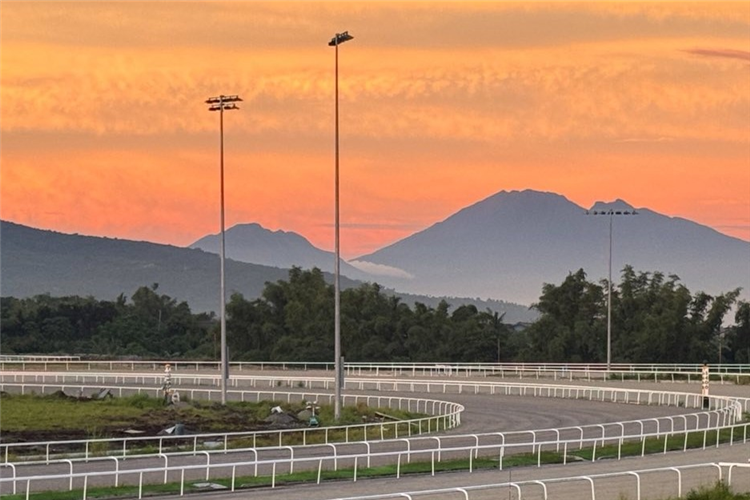
Situated on the rolling plains of Padre Garcia with the picturesque backdrop of Mount Malepunyo, the former coconut plantation where native workers toiled under the hot sun to harvest the bountiful fruit, has now been transformed into a state-of-the-art racing complex. The racetrack is right in the heart of Philippine horse breeding country, near the rapidly expanding area of Lipa City, Batangas.
Highly acclaimed USA racetrack designer Steve Wood, was the man the Philippine Jockey Club tasked with the design and layout of the racing circuit. Wood, whose track expertise has been used at many major racetracks in the USA, is a globetrotting trouble shooter that has worked in places such as Dubai, Saudi Arabia, Hong Kong, and Randwick, and was recently back in the Philippines to inspect the track, and give it the green light for racing.
The centerpiece of the new facility are two twin oval sand tracks complete with vertical drainage, with a five percent angled camber on the main outer track that is 1600 meters in circumference. The inside course that serves as a multi-purpose training track and racetrack, is 1525 meters in length. It's a track unlike no other in the Philippines. Along with its superb layout and exceptional draining powers, its sweeping cambered turns and long run down the homestretch, offers every runner a fair chance.
The track drainage was recently given the acid test on September 25, when was massive 125mm (five inches) of rain was dropped on the track in the space of a few hours, yet two hours after the deluge ceased, the club conducted eleven barrier trials with track riding on the fast side.
The racetracks are fully equipped for night racing with state-of-the-art lighting provided by Musco Sports & Entertainment Lighting (USA), the world-renowned providers of lighting for sporting and entertainment arenas around the globe. The entire complex is powered inhouse by two high volage diesel-powered on-site generators, with a Cummins 2-1MVA for Track Lighting and a Cummins 3-750KVA for the Grandstands and Administration Complex.
In stage one 1200 ultramodern stables have been constructed. These box stalls are set in large high ceiling barns with center walkways, to provide maximum airflow and cooling for the comfort of horses. At present another 600 stables are under construction, and, when fully completed the complex will have a stabling capacity of 2000 horses. The stabling barns also include staff accommodation, to allow around the clock care for horses.
The stabling complex will be complimented, by a specialized horseshoe shaped equine pool, for the conditioning and rehabilitation of horses. On course farrier services, and 24/7 veterinary services and emergency facilities are available. Future projects will include an Apprentice Jockeys' Academy of the highest standard, for the training and development of our future generations of riders.
The Hapi Jockey Club Incorporated will trade under the banner of the Philippine Jockey Club, and will be spearheaded by Chairman Oliver "Jojo" Valesquez and President Raymund Puyat, both renowned long standing owner breeders with a passion for horse racing.
In a significant boost to the original Hapi Group they were later joined by another Titan in Philippine racing, in Leyte Vice-Governor Leonardo "Sandy" Javier Jr, a multi award winning owner-breeder who is now a major investor in the Club and sits as Vice-Chairman. Javier is the owner and founder of the mammoth Andok's Chicken Franchise, and has been a constant in Philippine racing for over 35 years, breeding such champion horses as Strong Material, Empire King and the great Wind Blown, arguably the Philippines greatest racehorse.
The members of the small Hapi Group at present have over 300 horses in training which accounts for around 25% of the current registered Filpino horse population. Add to that their significant breeding interests with their stud farms located nearby, they are real powerhouses in the local racing industry.
The groups undying love for the racing and breeding industry has now seen them emerge as champions of the industry not only for their salvation of the local racing product, but their fierce determination to elevate Philippine racing to the world stage. For them the project is purely a labor of love.
Club President Raymund Puyat see's the opening of the Padre Garcia track as a pivotal turning point in the Philippine racing history.
"Thoroughbred breeding and racing in the Philippines has come a long way since the days of the pioneering tracks in Manila and Santa Ana. When those tracks started thoroughbreds were like unicorns. Presently though, many progeny of top stallions in the US and Australia, from Tapit, Into Mischief, Gun Runner, and Justify to Danehill, Smart Missile, Fastnet Rock and Street Boss to name a few, are racing in the Philippines. It is obvious that breeding and racing has truly been elevated.
"What the country therefore needs is a racecourse that will likewise elevate the standards of Philippine horse racing. This is one of the visions of PJCI. We are a small group of passionate horse owners who want what is best for Philippine horse racing."
The Filipino people like most Asian cultures love to gamble. The nation's most popular sport by standard rankings is basketball, however, when it comes to gambling revenue it is vastly overshadowed by traditional Cockfighting or "Sabong" as it's known locally. It is a billion-dollar industry that provides a source of income for many, especially those in the provinces.
Horse racing in the Philippines suffers greatly from a lack of promotion, it's rarity to see a news article about horse racing in any of the major newspapers, likewise on any television or cable channel. Yet, at the recent Klub Don Juan Racing Festival held at the old Malvar track, betting turnover topped PHP 82,000,000 (A$2.2 million) for the two-day racecard of twenty-two races.
All this is about to change with the Philippine Jockey Club's newly launched website dedicated to promoting racing and breeding, and providing racegoers with up-to-date form data and racing news. They are embarking on a vigorous promotional campaign to attract new players into the industry, and with a nation of 116 million people, the future potential is unlimited.
Wednesday November 12 is the first day of racing at the new track, however, the soft opening day is set down on for Sunday November 16 the second day of the Metropolitan Association of Race Horse Owners (MARHO) Racing Festival. How fitting is it that Sundays feature race is the Ambassador Eduardo "Danding" Cojuangco Jr Memorial Cup.
The Hapi Group that drew so much of their guidance and inspiration from both "Danding" and Henry Cojuangco, will no doubt be feeling their heavenly blessings and presence on the day, as a new chapter begins in Philippine racing history.

Check out the latest South African News